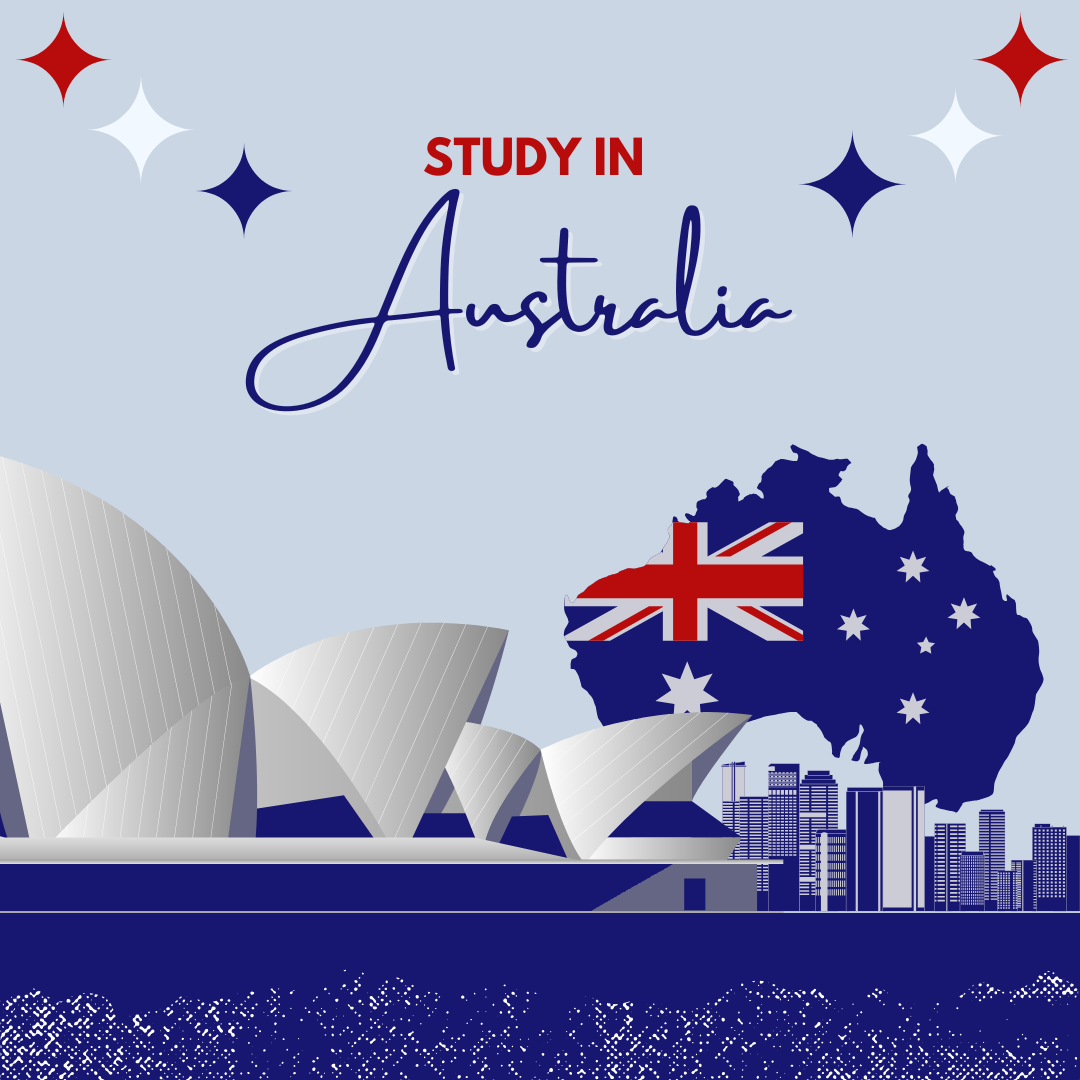

Australia is a contemporary, democratic nation with excellent healthcare, top-notch educational institutions, and a unique geography. Studying in Australia is particularly a terrific option for students to advance their education and professional opportunities, whether it’s because of the exciting way of life, welcoming culture, or excellent educational resources.
| Key Facts to Study in Australia | |
| Language spoken | English |
| Cost of study | Undergraduate- AUD 20,000 to AUD 45,000 per year, Post-graduate- AUD 22,000 to AUD 50,000 per year. |
| Source of funding | Scholarships, personal savings, part-time work, educational loans, and sponsorships |
| Exams required | IELTS, TOEFL, or PTE Academic |
| Degrees | Undergraduate, post-graduate, Doctoral, vocational courses. |
| Intakes | February/March and July/August. |
| Visa | Student visa subclass 500. |
Interesting facts about Australia
- Australia is the world’s 13th-largest economy and has the world’s fifth-highest per capita income.
- Australia is the fourth-happiest country.
- Over 260 languages are spoken in Australia.
- 5 out of the 30 best student cities in the world are in Australia.
- 8 out of the 100 top universities in the world are Australian universities.
- Australia is ranked 9th in the world in the university system ranking.
- Australia is the 3rd most popular destination for international students.
- 5 of the top 40 cities with the best urban infrastructure are in Australia.
- Melbourne has been ranked the world’s most liveable city for the past 3 years.
Popular Courses to Study in Australia:
Attracting students from all corners of the globe, studying in Australian universities is a dream come true for many. Here are seven popular courses in Australia that many international learners choose to pursue:
| S.N | Course |
| 1 | Accounting |
| 2 | Architecture |
| 3 | Computer Science & IT |
| 4 | Tourism & Hospitality Management |
| 5 | Psychology |
| 6 | Engineering |
| 7 | Nursing |
| 8 | Health & Medicine |
| 9 | Education |
| 10 | Social Work |
Cost of Living in Australia
| Expense Category | Average Monthly Cost (in AUD) |
| Accommodation | $800 – $1,500 |
| Groceries | $200 – $400 |
| Eating Out | $200 – $400 |
| Public Transportation | $100 – $200 |
| Utilities | $100 – $200 |
| Internet and Mobile | $50 – $100 |
| Entertainment | $100 – $200 |
| Personal Care | $50 – $100 |
| Clothing | $50 – $100 |
Top Universities in Australia
| S.N | University | World University Rank 2023 | Australia Rank 2023 |
| 1 | University of Melbourne | 34 | 1 |
| 2 | Monash University | 44 | 2 |
| 3 | The University of Queensland | 53 | 3 |
| 4 | University of Sydney | 54 | 4 |
| 5 | Australian National University | 62 | 5 |
| 6 | UNSW Sydney | 71 | 6 |
| 7 | University of Adelaide | 88 | 7 |
| 8 | The University of Western Australia | 131 | 8 |
| 9 | University of Technology Sydney | 133 | 9 |
| 10 | Macquarie University | 175 | 10 |
Popular cities where students live in Australia
- Melbourne
- Sydney
- Perth
- Adelaide
- Brisbane
- Canberra
- Hobart
- Darwin
- Wollongong
Requirements to Study in Australia:
To understand how to study in Australia, you must also understand the admission requirements for different courses in Australia:
- Admission to an Australian educational institution with national recognition is essential, requiring both the institution and the chosen course to meet specific academic and English language proficiency standards.
- Demonstrating financial capacity is a key requirement for studying in Australia, with evidence of funds needed to cover tuition fees, living expenses, and health insurance being mandatory to ensure students can support themselves during their stay.
- Providing a statement confirming genuine temporary entrant (GTE) status is necessary when applying for a student visa, indicating that the intention to study in Australia is temporary and that the individual plans to return home after completing their studies.
Intakes to Study in Australia:
Universities typically provide two primary intakes in Australia for foreign students:
| Intake | Timeframe | Application Period |
| Semester 1 | February to June | August to November of the previous year |
| Semester 2 | July to November | December to April of the same year |
| Summer | December to February | May to July of the same year |
Cost of Studying in Australia:
Below is a table providing an approximate range of annual tuition fees for international students studying in Australia:
| Level of Study | Average Annual Tuition Fees (in AUD) |
| Undergraduate | $20,000 – $45,000 |
| Postgraduate | $22,000 – $50,000 |
| Doctoral Degree | $18,000 – $42,000 |
| PhD | $22,000 – $50,000 |
Note: The cost mentioned above is based on estimated figures from the college and university average and does not confirm the fees you may pay.
Scholarships to Study in Australia:
For Nepalese students considering higher education in Australia, it is of the utmost importance to assess the financial components associated with this decision. Along with tuition fees and living expenses, various other costs, such as textbooks, must be taken into account. Fortunately, there are numerous scholarships to provide financial aid for Nepalese students. Here is a list of scholarship in Australia:
- Australia Awards
- Endeavour Postgraduate Scholarship
- International Postgraduate Research Scholarships (IPRS)
- Research Training Program (RTP) Scholarships
- University-specific Scholarships
- Government and Private Organisation Scholarships
Frequently asked questions
Reasons to study in Australia
Australia offers numerous benefits for international students. It has world-class universities, a high standard of education, a safe and welcoming environment, diverse cultural experiences, and excellent post-study work opportunities. The country’s vibrant lifestyle, stunning landscapes, and quality of life make it an attractive destination for education.
Why Australia?
Australia is renowned for its quality education system and has a strong reputation for academic excellence. It offers a wide range of courses and programmes across various disciplines. Additionally, Australia’s multicultural society, English-speaking environment, and emphasis on student support make it an ideal choice for international students.
Best Place to study?
Australia has several top-notch cities known for their educational institutions. Melbourne, Sydney, Brisbane, Perth, and Adelaide are popular choices among students due to their reputable universities, diverse student communities, and cultural attractions. The choice of the finest place to study depends on individual preferences and the specific courses available at different universities.
Qualification required
An academic score of 60% and a minimum band score of 6 in English proficiency are required for applying to Australian universities from international students.
Is IETLS mandatory?
Yes, English language proficiency is a requirement for studying in Australia. The International English Language Testing System (IELTS) is widely accepted as evidence of English proficiency by Australian universities. However, some institutions may accept other English language tests such as TOEFL or the Pearson Test of English (PTE) Academic. It’s important to check the specific language requirements of the chosen institution.
Overseas Student Health Cover (OSHC)
All international students are required to have OSHC throughout their stay in Australia. OSHC provides access to a range of medical services and helps cover the cost of medical treatments, hospital stays, prescription medications, and emergency services.
OSHC covers a portion of the medical expenses incurred by international students. It also provides limited coverage for pharmaceuticals and hospital services. The coverage may vary depending on the insurance provider and the plan chosen.
Student Visa Process for Australia
The student visa process for Australia involves several steps. Firstly, you need to be accepted into a recognized Australian educational institution and receive a Confirmation of Enrollment (CoE) letter. Then, you can create an account on the Department of Home Affairs website and submit your student visa application online. You will need to provide documents such as your COE, proof of financial capacity, health insurance, and English language proficiency. After submitting the application, you will be required to undergo a health examination and may need to attend an interview at the Australian embassy or consulate.
Job Opportunities in Australia
Australia provides many job opportunities for international students. Here are some key points about job opportunities in Australia:
- Work Right: International students with a valid student visa are generally allowed to work part-time during their studies. They can work up to 48 hours per fortnight during the academic term and full-time during scheduled breaks.
- Availability of Jobs: has a strong economy and a diverse range of industries, offering job opportunities in sectors such as hospitality, retail, administration, healthcare, and more. Major cities like Sydney, Melbourne, Brisbane, and Perth have a higher concentration of job opportunities.
- Minimum Wage: Australia has one of the highest minimum wages globally, providing students with fair remuneration for their work. The minimum wage varies based on age, but it is generally around AU$21.38 per hour.
- Job Search Support: Australian universities and institutions often provide career services and job placement assistance to help students find employment opportunities. They offer resources, workshops, and guidance on resume writing, interview skills, and job search strategies.
- Post-Study Work Opportunities: After graduation, international students may be eligible for the Post-Study Work Stream of the Temporary Graduate Visa (subclass 485), allowing them to work in Australia for a period of two to four years, depending on their level of study.
PR process
While studying in Australia can provide opportunities for obtaining permanent residency (PR), it is not automatic or guaranteed. Australia has various pathways for PR, such as skilled migration visas, employer sponsorship, or state or territory nominations. Meeting the eligibility criteria, including work experience, English language proficiency, and occupation demand, is essential. Obtaining PR after studying in Australia requires careful planning, meeting the visa requirements, and complying with immigration regulations. It’s advisable to consult with a qualified migration agent for personalised advice regarding PR pathways.